S3 Bucket Migration

· 2 min read

Electron is changing its primary S3 bucket, you may need to update your build scripts


What is happening?

A significant amount of Electron's build artifacts are uploaded to an S3 bucket called gh-contractor-zcbenz. As part of ongoing infrastructure/ownership migrations that started way back in 2020, we will be changing everything that used gh-contractor-zcbenz from its old home in S3 to a new storage system hosted at https://artifacts.electronjs.org. The path prefix that most of our assets use is changing slightly as well. Examples are included below:

Before: https://gh-contractor-zcbenz.s3.amazonaws.com/atom-shell/dist/v17.0.0/node.lib After: https://artifacts.electronjs.org/headers/dist/v17.0.0/node.lib

The important things here are the Hostname changed and the /atom-shell prefix changed. Another example, this time for debug symbols:

Before: https://gh-contractor-zcbenz.s3.amazonaws.com/atom-shell/symbols/path/to/symbol.pdb After: https://artifacts.electronjs.org/symbols/path/to/symbol.pdb

Again, the hostname changed and the /atom-shell prefix was changed.

How might this impact you?

Anyone using standard build tooling such as electron-rebuild, electron-packager or @electron/get won't have to do anything. This should be the majority of people.

For anyone directly referencing the S3 bucket, you must update your reference to point at the hostname and update the path as well.

What about existing data?

Most data that existed on the gh-contractor-zcbenz bucket has been cloned into the new storage system. This means all debug symbols and all headers have been copied. If you relied on some data in that bucket that hasn't been copied over please raise an issue in electron/electron and let us know.

The current gh-contractor-zcbenz S3 bucket will not be actively deleted. However, we can't guarantee how long that bucket will be left alive. We strongly recommend updating to target the new bucket as soon as possible.

Electron 18.0.0

· 4 min read

Electron 18.0.0 has been released! It includes upgrades to Chromium 100, V8 10.0, and Node.js 16.13.2. Read below for more details!


The Electron team is excited to announce the release of Electron 18.0.0! You can install it with npm via npm install electron@latest or download it from our releases website. Continue reading for details about this release and please share any feedback you have!

Electron Release Cadence Change

As of Electron 15, Electron will release a new major stable version every 8 weeks. You can read the full details here.

Additionally, Electron has changed supported versions from latest three versions to latest four versions until May 2022. See our versioning document for more detailed information about versioning in Electron. After May 2022, we will return to supporting latest three versions.

Notable Changes

  • Added ses.setCodeCachePath() API for setting code cache directory. #33286
  • Removed the old BrowserWindowProxy-based implementation of window.open. This also removes the nativeWindowOpen option from webPreferences. #29405
  • Added 'focus' and 'blur' events to WebContents. #25873
  • Added Substitutions menu roles on macOS: showSubstitutions, toggleSmartQuotes, toggleSmartDashes, toggleTextReplacement. #32024
  • Added a first-instance-ack event to the app.requestSingleInstanceLock() flow, allowing users to seamlessly transmit data from the first instance to the second instance. #31460
  • Added support for more color formats in setBackgroundColor. #33364

See the 18.0.0 release notes for a full list of new features and changes.

Google Summer of Code 2022

· 2 min read

The Electron team is excited to announce that we will be participating in Google Summer of Code for the first time this year!


What is Google Summer of Code?

Google Summer of Code (GSoC) is a yearly mentoring program connecting open source software projects with potential contributors. Previously open only to students, anyone ages 18 and up can now register for GSoC.

For more information, check out the Summer of Code homepage.

How do I sign up?

Are you interested in collaborating with Electron? If you are a new or beginner open source contributor, we welcome you to apply!

In order to be selected as an Electron contributor for Google Summer of Code, you will need to submit an application. Applications will open on April 4th, 2022 and close on April 19th, 2022. You can follow updates for Google: Summer of Code application guidelines here.

Want to apply? First, check out the five project idea drafts that we have prepared. All of the listed ideas are currently open for proposals. We are also open to accepting new ideas that are not on the proposed project list.

Your application should include:

  • Your proposal, which is a written document that describes in detail what you plan to achieve over the course of the summer.
  • Your background as a developer. If you have a resume, please include a copy, otherwise tell us about your past experience with an emphasis on relevant technical experience.

A detailed guide of what to submit as part of your Electron application is here.

You can also read through the official GSoC student/contributor guide for important tips on preparing your proposal.

If you want to discuss project proposals or have questions, come hang out in our #gsoc-general Discord channel!

References

Electron 17.0.0

· 4 min read

Electron 17.0.0 has been released! It includes upgrades to Chromium 98, V8 9.8, and Node.js 16.13.0. Read below for more details!


The Electron team is excited to announce the release of Electron 17.0.0! You can install it with npm via npm install electron@latest or download it from our releases website. Continue reading for details about this release and please share any feedback you have!

Electron Release Cadence Change

As of Electron 15, Electron will release a new major stable version every 8 weeks. You can read the full details here.

Additionally, Electron has changed supported versions from latest three versions to latest four versions until May 2022. See our versioning document for more detailed information about versioning in Electron. After May 2022, we will return to supporting latest three versions.

Notable Changes

  • Added webContents.getMediaSourceId(), can be used with getUserMedia to get a stream for a WebContents. #31204
  • Deprecates webContents.getPrinters() and introduces webContents.getPrintersAsync(). #31023
  • desktopCapturer.getSources is now only available in the main process. #30720

See the 17.0.0 release notes for a full list of new features and changes.

Spectron Deprecation Notice

· 2 min read

Spectron will be deprecated on February 1st, 2022.


Beginning in February 2022, Spectron will be officially deprecated by the Electron team.

Why Deprecate Spectron?

While Spectron has consistently put out new releases for each new version of Electron, the project has had very little maintenance and improvements for well over a year, and currently has no full-time maintainers. With the remote module moving outside of Electron core and into an external module in Electron 14, Spectron will require a major rewrite to continue working reliably.

After reviewing several available options for Spectron's continued maintenance, the Electron team has decided to deprecate Spectron in 2022.

Deprecation Timeline

The following is our planned deprecation timeline:

  • November 2021 - January 2022: The Electron team will continue to accept pull requests from the community.
  • January 2022: A final version of announcement warning about Spectron's deprecation will be released.
  • February 1, 2022: Spectron's repo will be marked as "archived". No more pull requests will be accepted.

Following February 1st, 2022, Electron will continue to leave the Spectron repo up indefinitely, so that others are welcome to fork or use the existing code for their projects. We hope this will help provide a longer transition to any projects that may still depend on Spectron.

Alternatives to Spectron

If you're currently using Spectron in your project and would like to migrate to an alternative testing solution, you can read our guide for automated testing here.

We currently have several other recommended alternatives to Spectron, including Playwright and WebDriverIO. Official tutorials for each option can be found in our Automated Testing documentation.

What's Next

We here on the Electron team appreciate you using Spectron and Electron. We understand that many of you depend on Spectron for testing your apps, and we want to make this transition as painless for you as possible. Thank you for choosing Electron!

Electron 16.0.0

· 4 min read

Electron 16.0.0 has been released! It includes upgrades to Chromium 96, V8 9.6, and Node.js 16.9.1. Read below for more details!


The Electron team is excited to announce the release of Electron 16.0.0! You can install it with npm via npm install electron@latest or download it from our releases website. Continue reading for details about this release and please share any feedback you have!

Electron Release Cadence Change

As of Electron 15, Electron will release a new major stable version every 8 weeks. You can read the full details here.

Additionally, Electron has changed supported versions from latest three versions to latest four versions until May 2022. See our versioning document for more detailed information about versioning in Electron. After May 2022, we will return to supporting latest three versions.

Notable Changes

  • Now supports the WebHID API. #30213
  • Add data parameter to app.requestSingleInstanceLock to share data between instances. #30891
  • Pass securityOrigin to media permissions request handler. #31357
  • Add commandLine.removeSwitch. #30933

See the 16.0.0 release notes for a full list of new features and changes.

A Quiet Place (Dec'21)

· 2 min read

The Electron project will pause for the month of December 2021, then return to full speed in January 2022.

via GIPHY


What will be the same in December

  1. Zero-day and other major security-related releases will be published as necessary. Security incidents should be reported via SECURITY.md.
  2. Code of Conduct reports and moderation will continue.

What will be different in December

  1. No new Beta or Stable releases in December. No Nightly releases for the last two weeks of December.
  2. With few exceptions, no pull request reviews or merges.
  3. No issue tracker updates on any repositories.
  4. No Discord debugging help from maintainers.
  5. No social media content updates.

Why is this happening?

In short, while maintainers are happy and engaged with the project, THE WORLD IS TIRED. December is a quiet month for most companies, so we want to give our maintainers a chance to recharge. We encourage other projects to consider similar measures.

Should I be worried about the future of Electron?

No. We are able to take this step because the project is in good shape. Everyone is looking forward to 2022, and we expect good things to come!

Electron 15.0.0

· 5 min read

Electron 15.0.0 has been released! It includes upgrades to Chromium 94, V8 9.4, and Node.js 16.5.0. We've added API updates to window.open, bug fixes, and general improvements. Read below for more details!


The Electron team is excited to announce the release of Electron 15.0.0! You can install it with npm via npm install electron@latest or download it from our releases website. Continue reading for details about this release and please share any feedback you have!

Electron Release Cadence Change

Starting with Electron 15, Electron will release a new major stable version every 8 weeks. You can read the full details here.

Additionally, Electron will be changing supported versions from latest three versions to latest four versions until May 2022. See our versioning documentfor more detailed information about versioning in Electron.

Notable Changes

  • nativeWindowOpen: true is no longer experimental, and is now the default.
  • Added safeStorage string encryption API. #30430
  • Added 'frame-created' event to WebContents which emits when a frame is created in the page. #30801
  • Added resize edge info to BrowserWindow's will-resize event. #29199

See the 15.0.0 release notes for a full list of new features and changes.

Electron 14.0.0

· 7 min read

Electron 14.0.0 has been released! It includes upgrades to Chromium 93 and V8 9.3. We've added several API updates, bug fixes, and general improvements. Read below for more details!


The Electron team is excited to announce the release of Electron 14.0.0! You can install it with npm via npm install electron@latest or download it from our releases website. Continue reading for details about this release and please share any feedback you have!

Electron Release Cadence Change

Beginning in September 2021 with Electron 15, Electron will release a new major stable version every 8 weeks. You can read the full details here. Electron 15 will begin beta on September 1, 2021 and stable release will be on September 21, 2021. You can find Electron's public timeline here. Additionally, Electron will be changing supported versions from latest three versions to latest four versions until May 2022. See see our versioning document for more detailed information about versioning in Electron.

Notable Changes

  • Default Changed: nativeWindowOpen now defaults to true. (see docs)
  • Child windows no longer inherit BrowserWindow construction options from their parents. #28550
  • Added new session.storagePath API to get the path on disk for session-specific data. #28665
  • Added process.contextId used by @electron/remote. #28007
  • Added experimental cookie encryption support behind an Electron Fuse. #29492

See the 14.0.0 release notes for a full list of new features and changes.

WebView2 and Electron

· 6 min read

Over the past weeks, we’ve received several questions about the differences between the new WebView2 and Electron.

Both teams have the expressed goal of making web-tech the best it can be on the Desktop, and a shared comprehensive comparison is being discussed.

Electron and WebView2 are fast-moving and constantly evolving projects. We have assembled a brief snapshot of similarities and differences between Electron and WebView2 as they exist today.


Architecture Overview

Electron and WebView2 both build from the Chromium source for rendering web content. Strictly speaking, WebView2 builds from the Edge source, but Edge is built using a fork of the Chromium source. Electron does not share any DLLs with Chrome. WebView2 binaries hard link against Edge (Stable channel as of Edge 90), so they share disk and some working set. See Evergreen distribution mode for more info.

Electron apps always bundle and distribute the exact version of Electron with which they were developed. WebView2 has two options in distribution. You can bundle the exact WebView2 library your application was developed with, or you can use a shared-runtime version that may already be present on the system. WebView2 provides tools for each approach, including a bootstrapping installer in case the shared runtime is missing. WebView2 is shipped inbox starting with Windows 11.

Applications that bundle their frameworks are responsible for updating those frameworks, including minor security releases. For apps using the shared WebView2 runtime, WebView2 has its own updater, similar to Chrome or Edge, that runs independent of your application. Updating the application's code or any of its other dependencies is still a responsibility for the developer, same as with Electron. Neither Electron nor WebView2 is managed by Windows Update.

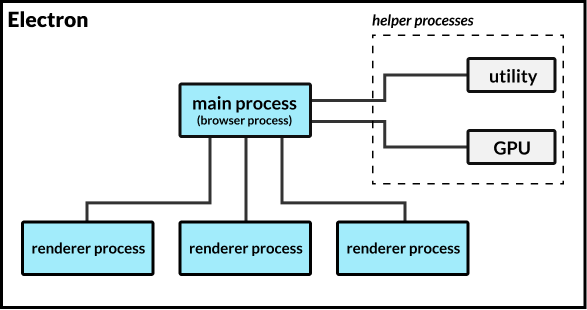
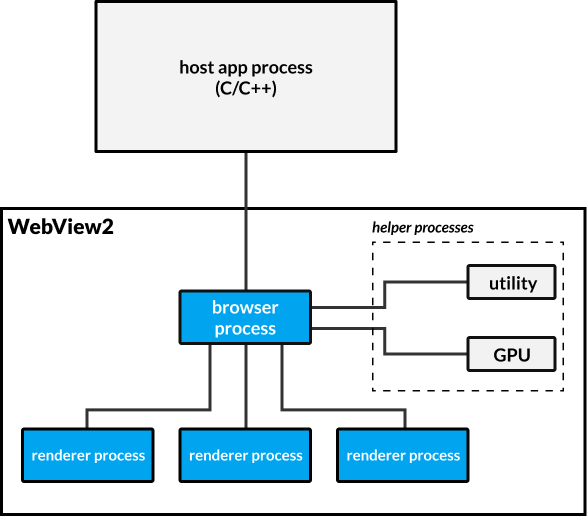
Both Electron and WebView2 inherit Chromium’s multi-process architecture - namely, a single main process that communicates with one-or-more renderer processes. These processes are entirely separate from other applications running on the system. Every Electron application is a separate process tree, containing a root browser-process, some utility processes, and zero or more render processes. WebView2 apps that use the same user data folder (like a suite of apps would do), share non-renderer processes. WebView2 apps using different data folders do not share processes.

  • ElectronJS Process Model:

    ElectronJS Process Model Diagram

  • WebView2 Based Application Process Model:

    WebView2 Process Model Diagram

Read more about WebView2’s process model and Electron’s process model here.

Electron provides APIs for common desktop application needs such as menus, file system access, notifications, and more. WebView2 is a component meant to be integrated into an application framework such as WinForms, WPF, WinUI, or Win32. WebView2 does not provide operating system APIs outside the web standard via JavaScript.

Node.js is integrated into Electron. Electron applications may use any Node.js API, module, or node-native-addon from the renderer and main processes. A WebView2 application does not assume which language or framework the rest of your application is written in. Your JavaScript code must proxy any operating system access through the application-host process.

Electron strives to maintain compatibility with the web API, including APIs developed from the Fugu Project. We have a snapshot of Electron’s Fugu API compatibility. WebView2 maintains a similar list of API differences from Edge.

Electron has a configurable security model for web content, from full-access to full-sandbox. WebView2 content is always sandboxed. Electron has comprehensive security documentation on choosing your security model. WebView2 also has security best practices.

The Electron source is maintained and available on GitHub. Applications can modify can build their own brands of Electron. The WebView2 source is not available on GitHub.

Quick Summary:

ElectronWebView2
Build DependencyChromiumEdge
Source Available on GitHubYesNo
Shares Edge/Chrome DLLsNoYes (as of Edge 90)
Shared Runtime Between ApplicationsNoOptional
Application APIsYesNo
Node.jsYesNo
SandboxOptionalAlways
Requires an Application FrameworkNoYes
Supported PlatformsMac, Win, LinuxWin (Mac/Linux planned)
Process Sharing Between AppsNeverOptional
Framework Updates Managed ByApplicationWebView2

Performance Discussion

When it comes to rendering your web content, we expect little performance difference between Electron, WebView2, and any other Chromium-based renderer. We created scaffolding for apps built using Electron, C++ + WebView2, and C# + WebView2 for those interested to investigate potential performance differences.

There are a few differences that come into play outside of rendering web content, and folks from Electron, WebView2, Edge, and others have expressed interest in working on a detailed comparison including PWAs.

Inter-Process Communication (IPC)

There is one difference we want to highlight immediately, as we believe it is often a performance consideration in Electron apps.

In Chromium, the browser process acts as an IPC broker between sandboxed renderers and the rest of the system. While Electron allows unsandboxed render processes, many apps choose to enable the sandbox for added security. WebView2 always has the sandbox enabled, so for most Electron and WebView2 apps IPC can impact overall performance.

Even though Electron and WebView2 have a similar process models, the underlying IPC differs. Communicating between JavaScript and C++ or C# requires marshalling, most commonly to a JSON string. JSON serialization/parsing is an expensive operation, and IPC-bottlenecks can negatively impact performance. Starting with Edge 93, WV2 will use CBOR for network events.

Electron supports direct IPC between any two processes via the MessagePorts API, which utilize the structured clone algorithm. Applications which leverage this can avoid paying the JSON-serialization tax when sending objects between processes.

Summary

Electron and WebView2 have a number of differences, but don't expect much difference with respect to how they perform rendering web content. Ultimately, an app’s architecture and JavaScript libraries/frameworks have a larger impact on memory and performance than anything else because Chromium is Chromium regardless of where it is running.

Special thanks to the WebView2 team for reviewing this post, and ensuring we have an up-to-date view of the WebView2 architecture. They welcome any feedback on the project.